

Portable Air Conditioners
- How does a Portable Air Conditioner work?
- How to choose the right Air Con Unit?
- Things to consider when buying a Portable Air Conditioner
- FAQ
Discover Klarstein’s Portable Air Conditioner Deals!
How does a Portable Air Conditioner work?
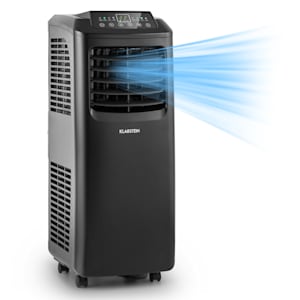
The cooling system of a portable air con works due to using a refrigerant gas undergoing changes between gaseous and liquid state, after being compressed inside the air conditioner itself and then expanded in the evaporator. Here, the air cools down until it reaches the desired temperature. At this point, it is conveyed into the room through a ventilation system, while the hot air, which is part of this thermo-dynamic cycle, is expelled outside the room through a special flexible pipe.
The drop in room temperature is achieved mainly by the ratio between the size of the room and the power of the appliance, measured in BTUs (short for British Thermal Units per hour). For adequate cooling in a room with a ceiling of up to 3 metres, you’ll need an output of 340 BTUs per square metre.
Therefore, for a 30 square metres room, choose a portable air conditioner capable of developing around 10000 BTUs. However, there are additional factors to consider: very high ceilings, southern exposure of the room, heat-generating appliances, and high average temperatures in the area add to count, meaning you would need additional BTUs.
How to choose the right Air Con Unit?
Things to consider when buying a Portable Air Conditioner
FAQ
What size air conditioner (BTU level) do I need?
The BTU level of the air conditioner required for cooling a room depends on the room's size. To determine the appropriate BTUs, a general guideline is to have 20 BTUs of cooling power for each square foot of living space.
For instance, a 20,000 BTU air conditioner would be needed for a 1,000 square foot living room. However, factors such as the number of windows, ceiling height, and room insulation may impact the cooling needs. Therefore, to ensure the correct size for your specific requirements, it is recommended to seek advice from an HVAC professional.
How do portable air conditioners drain water?
Most portable air conditioners have a mechanism that removes the excess water collected during the cooling process. This is generally achieved using a drainage hose that can be linked to a nearby window or drain. There are some models that have a self-evaporative system, which eliminates the need for manual draining. The water is evaporated and released through the exhaust hose in this system. To prevent overflow and maintain the unit's efficiency, it is critical to frequently check and empty the water tank.
What should I do if my portable air conditioner won't turn on?
When your portable air conditioner fails to turn on, there are various reasons that might be causing it. Firstly, ensure that it is firmly connected to a power source and switched on. If it's connected and still not working, try another device to see if the outlet is functioning correctly. If the outlet is functional, the problem could be the circuit breaker or fuse. Additionally, a malfunctioning control board or defective thermostat could also be the cause. It is advisable to seek assistance from a professional to identify and resolve the issue in such circumstances.
How can I reduce the noise level of my portable air conditioner?
To decrease the noise produced by your portable air conditioner, there are various techniques you can implement. Initially, it is important to place the unit on a stable and even surface to avoid vibrations. Additionally, you can try situating it on a carpet or rubber mat to diminish some of the noise. Secondly, it is crucial to clean or replace the air filter on a regular basis as a dirty filter may cause the unit to work harder and create more noise. Lastly, you may want to consider purchasing a unit with a lower decibel rating or a "quiet mode" option.
How can I reduce my energy costs when using a portable air conditioner?
By following these tips, you can help reduce the energy costs when using a portable air conditioner: ensure that the air conditioner is appropriately sized for the room it is being utilized in since an excessive unit can result in higher energy expenses. Keep the windows and doors shut when the unit is running to prevent cool air from escaping. Use the air conditioner at night or in the evening when the outdoor temperature is cooler. Regularly clean or replace the air filter to maintain the unit's efficiency, and think about purchasing an air conditioner with an energy-efficient rating.