


Fridge Test & Guide
Need a new fridge? But what should you pay attention to when buying? What features does your fridge need? In our big test, we'll compare different models for you. From the design aspect to the energy rating, we'll walk you through how to find your best fridge. Whether it's a small fridge for the hobby room, a large model for the kitchen or the drinks fridge that always has cool drinks ready - here you can find out which criteria you should use to make your decision.
Top Sellers
Refrigerator: Comparison of features and performance
A refrigerator is one of the most important household appliances - and the choice of models is huge. From compact mini-fridges to spacious fridge-freezers, there is a suitable solution for every need. But before you decide on a model, you should ask yourself a few key questions: How much space do you have available? How many people live in the household? And what requirements do you have for the device? This guide will help you keep an overview.
The best fridge for you: Finding the right model
Firstly, it is important to choose the right type of appliance. A fridge with a built-in freezer compartment is ideal if you are looking for a compact solution that combines both functions. However, if you already have a separate freezer, a fridge without a freezer compartment is usually sufficient. A mini-fridge may be sufficient for small households or cramped spaces - for example in an office or student flat. If you like to cool drinks separately, for example for party rooms or lounges, you can use a special drinks refrigerator.
Size and capacity
The right size depends largely on how many people live in the household and how much you want to store in the fridge. A model with 100 to 150 litres is often sufficient for singles or couples. Appliances with at least 200 to 300 litres are recommended for families. Large households should plan for even more storage space. It is also important to measure the parking space precisely - including the door opening and ventilation clearance.
Energy consumption and efficiency
An energy-efficient refrigerator not only saves electricity costs, it also protects the environment. When buying, pay attention to the new EU energy label, which categorises the efficiency classes from A (very good) to G (less efficient). You will find particularly economical models in classes A or B. It is also worth taking a look at the power consumption of smaller appliances - after all, the refrigerator runs around the clock.
Do not underestimate the volume
The volume plays an important role, especially if you want to install your refrigerator in living rooms, bedrooms or home offices. Particularly quiet appliances operate at a noise level of 35 to 40 decibels - about as loud as a whisper. Pay attention to the corresponding information in the product details if operating noise could disturb you.
Fridge with freezer compartment - yes or no?
Whether you need a built-in freezer compartment depends on your habits. If you regularly use frozen products, you should make sure you have a sufficiently large and efficient freezer compartment - ideally with its own door. Smaller compartments are often only sufficient for ice cubes or small quantities.
Equipment and functions of refrigerators
Modern refrigerators offer a variety of practical functions. Models with no-frost technology, which make manual defrosting superfluous, are particularly convenient. An automatic defrost function also makes cleaning much easier. LED interior lighting ensures good visibility inside and saves energy at the same time. Adjustable shelves and door compartments offer flexibility, while freshness zones for fruit, vegetables or meat optimise storage. An acoustic door signal can also help to avoid energy losses.
Refrigerator: Design and installation options
Design also plays a role when buying a refrigerator - especially if the appliance is integrated into an open-plan kitchen. In addition to classic white and stainless steel versions, black or retro fridges are also in vogue. Also check whether the door hinge is interchangeable - this gives you more freedom when positioning the appliance in your kitchen or room.
When buying a fridge, you should keep both practical aspects and your personal everyday life in mind. Choosing the right type of appliance, the right volume, quiet operation and a good energy efficiency class are key criteria. Additional convenience functions can make your everyday life much easier. If you pay attention to these points, you are guaranteed to find a model that suits you and your home.
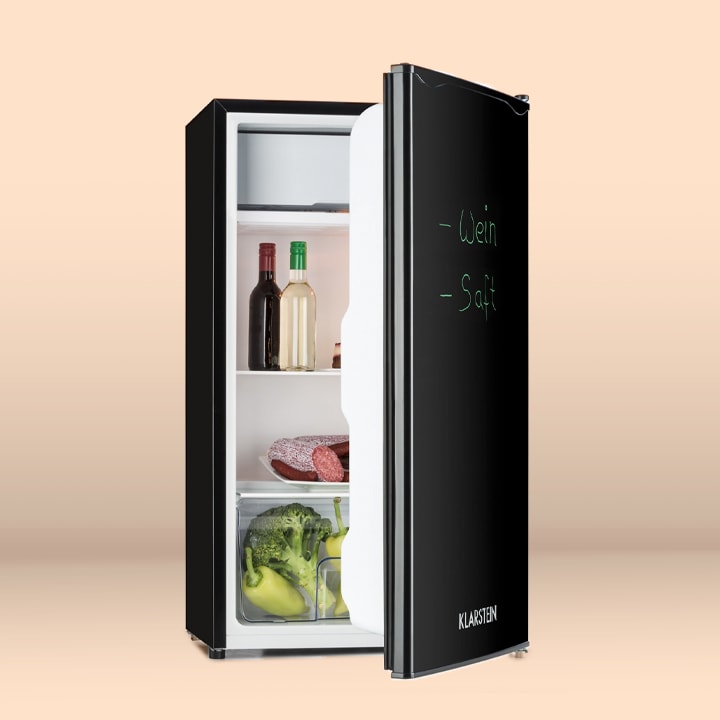
Free-standing fridge
Product Tip
Spitsbergen Uni
Free-standing refrigerators offer maximum flexibility when it comes to positioning in the kitchen or household. They are available in many sizes, colours and designs and are ready for immediate use without the need for permanent installation.
- Can be set up flexibly: No fixed installation space required
- Large selection of designs: From retro to modern
- Independent of kitchen furniture: No fixed built-in cupboard required
Fridge-freezer combination

Product Tip
Big Daddy Cool
Fridge-freezer combinations combine a fridge and freezer compartment in one space-saving appliance. They are ideal for anyone who wants to keep food fresh and freeze it at the same time.
- Space-saving solution: Fridge and freezer compartment in one appliance
- Energy-efficient: modern operation with low power consumption
- Practical layout: Separate temperature zones for optimum storage
Mini fridge

Product Tip
Happy Hour
A small fridge is ideal for single households, offices or as a second appliance. Despite its compact size, it offers enough space for drinks, snacks and everyday essentials.
- Space-saving: Fits in small kitchens, rooms or under tables
- Flexible use: Ideal for offices, guest rooms or camping
- Energy-efficient and quiet: Low power consumption and barely audible during operation
Drinks fridge

Product Tip
Beersafe XXL Onyx
A beverage fridge ensures that water, soft drinks or beer are pleasantly cool and ready to hand at all times. It is ideal for the kitchen, office, party room or hobby room.
- Optimum drinking temperature: Specially designed for bottles and cans
- Space-saving and clearly organised: Separate appliance for drinks storage
- Attractive design: Often with glass door and LED lighting for perfect presentation
Refrigerator Test – Differences and Similarities
| Model Type | Advantages | Disadvantages | Suitable For |
|---|---|---|---|
| Freestanding Refrigerator Without Freezer Compartment |
- Larger cooling capacity without freezer compartments - Easy to position and flexible setup - Often more energy-efficient due to the absence of a freezer compartment |
- No freezer compartment for ice cream, frozen goods, etc. - Not sufficient for many households |
- Households with a separate freezer - People who rarely use frozen food |
| Fridge With Freezer Compartment |
- Combined cooling and freezing function - Space-saving solution - Ideal for everyday use |
- Freezer compartment is usually smaller and less powerful - Less efficient than separate appliances |
- Singles, couples, small households - Normal kitchen with standard needs |
| Mini Fridge |
- Very compact, fits in small spaces - Ideal for offices, guest rooms, and student apartments - Low power consumption (with a good efficiency rating) |
- Very limited storage space - Often without a proper freezer compartment - Not ideal as a primary appliance |
- Students - Office workspaces - Vacation apartments - Hotels |
| Drinks Fridge |
- Specially designed for bottles and cans - Often with a glass door, ideal for display - Fast cooling, even temperature |
- Not suitable for food storage - No freezer function - Usually louder than standard refrigerators |
- Households with high beverage demand - Party rooms - Restaurants - Office lounges |
Practical Tips & Tricks for Fridges
A refrigerator is one of the most important household appliances, and with a few clever tricks you can extend its life, save energy and keep food fresh for longer. Here is an overview of the best tips:
Refrigerator: Set the right temperature
- The ideal temperature is 4-7 °C in the fridge and -18 °C in the freezer compartment.
- Too cold consumes an unnecessary amount of energy, too warm causes food to spoil more quickly.
Use Order and Zones
- Above: Cooked food, leftovers, dairy products.
- Centre: Sausage, cheese, yoghurt.
- Below: Meat and fish, as this is where it is coldest.
- Vegetable compartment: Store fruit and vegetables separately.
- Door compartments: Drinks, butter, sauces - not for milk or eggs, as this is where it is warmest.
Saving Energy
- Do not leave the fridge open for too long.
- Allow hot food to cool before putting it in.
- Do not place the appliance directly next to the cooker, heater or in the sun.
- Check door seals regularly to prevent cold from escaping.
Clean the Fridge Properly: Cleanliness and Hygiene
- Wipe out regularly (preferably with vinegar water).
- Dispose of expired or mouldy food immediately.
- Clean the seals and drainage channel to prevent mould and odours.
Clever Storage of Supplies
- FIFO principle: "First in, first out" - put older food at the front.
- Label the food (e.g. with the date).
- Store delicate foods such as berries or herbs in air-permeable boxes.
Extend Service Life
- So that the air can circulate, do not overfill the refrigerator.
- Defrost regularly if there is no no-frost system.
- Vacuum dust from the rear (cooling fins) at least once a year.
These tips will not only keep your fridge in top condition for longer, but also ensure that food stays fresh for longer and electricity costs are reduced.